· 5 min read
Snakes & Ladders was once a game about karma
Before it was a children's race, the Indian game of knowledge made the die your karma, the snakes your vices and the ladders your virtues. How that moral map worked.
Most of us met this board on a rainy afternoon: a hundred numbered squares, a die, a few cheerful ladders and a few smiling snakes. You climbed, you slid, somebody cried, somebody won. Nobody told you that the game once had a very different question in mind. Not “who gets to 100 first?” but “what carries a soul upward, and what drags it down?”
Its Indian ancestor was called the game of knowledge: gyan chaupar among Vaishnava Hindus, gyan bazi among Jains, mokshapat in Maharashtra, the board of liberation. It used the same moves you know. What it added was meaning, and the meaning had a name: karma.
Three things on the board, three ideas
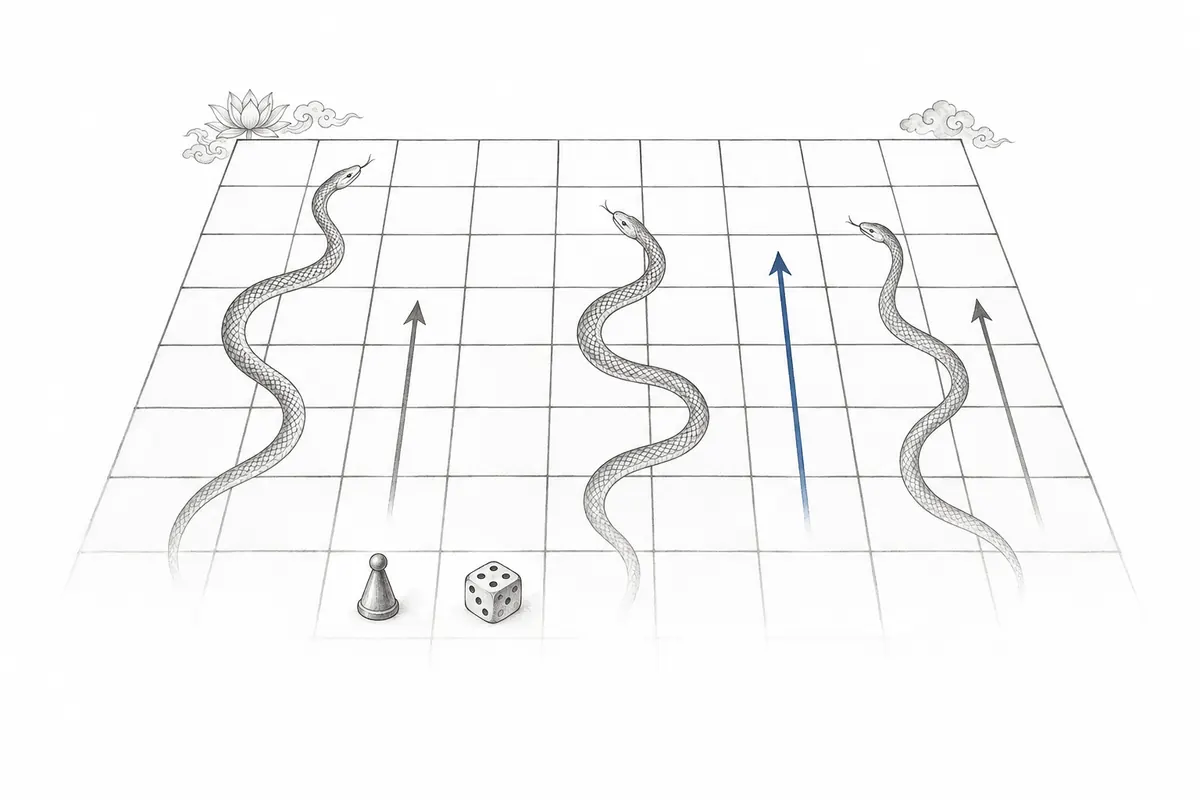
Verses written on surviving charts spell out the metaphor without any mystery. The dice are the player’s karma. The snakes are sins. The ladders are virtues. A text on the game published in 1872 puts it just as plainly: a good action lifts you, a bad one delivers you into the snake’s mouth.
Think about what that does to a simple race.
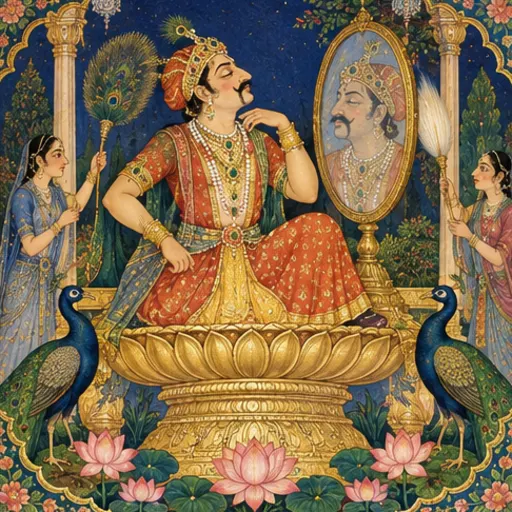
The die is karma. You do not choose your roll. You do not choose where you were born, what you inherited, which door opened and which closed. In the game, as in the old understanding of karma, the throw is the accumulated weight of what came before. It is not punishment and it is not luck. It is consequence arriving.
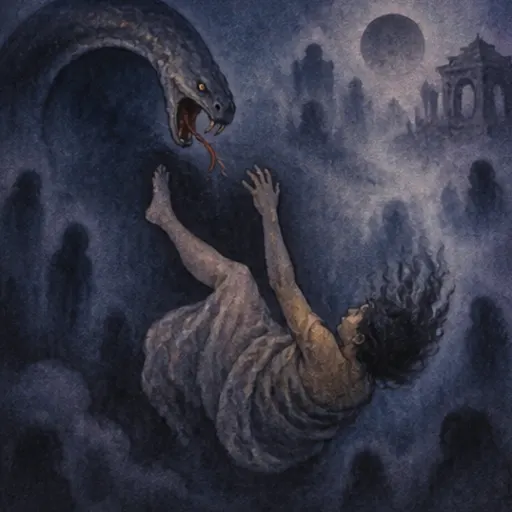
The snakes are vices. A snake’s head sits on a square named for a failing, and its tail lands you in the place that failing leads. You do not fall because the game is cruel. You fall because anger, pride or greed have a direction, and the board simply shows it.
The ladders are virtues. Their feet stand on squares of generosity, devotion, knowledge. Their tops reach heavens. A virtue is drawn not as a reward handed down, but as a structure you climb.
A map, not a scoreboard
The squares of an Indian board were not blank. They carried the names of virtues and vices, heavens and hells, states of mind and stages of the soul. A Jain gyan bazi board in the Victoria and Albert Museum is covered in small inscribed compartments; the museum describes its ladders as virtues and its snakes as the path to downfall.
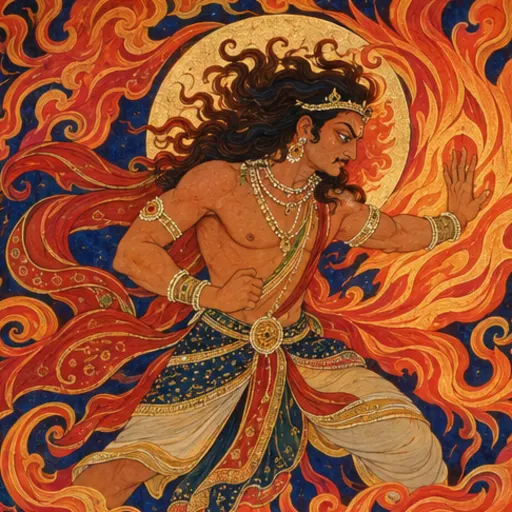 3 · Anger
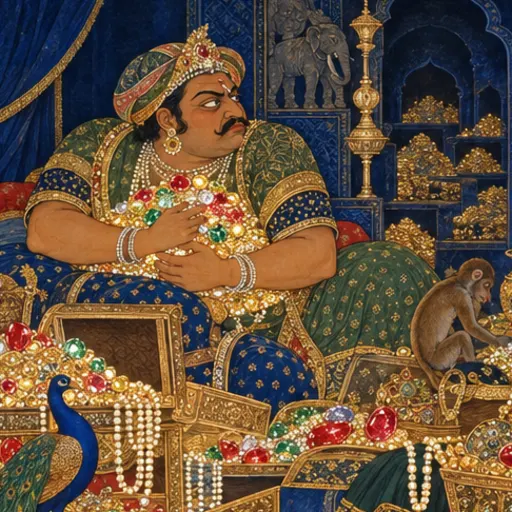 4 · Greed
 7 · Conceit
Even the number of squares was a statement. Andrew Topsfield, the art historian who wrote the first major study of these boards, found three main families: 72 squares on Hindu boards, 84 on Jain ones and 100 on Sufi ones. Jacob Schmidt-Madsen, who wrote a doctoral thesis on the game, explains the symbolism behind two of them. Eighty-four echoes the 8.4 million forms of birth a soul may pass through. Seventy-two recalls the 72,000 nadis, the channels of the subtle body. One board describes the cosmos; the other describes you.
And at the top there was no finishing line in the modern sense. There was liberation: Vaikuntha, Vishnu’s heaven, on Vaishnava boards; release from the cycle of birth on Jain ones. Reaching it was not winning. It was getting out of the game altogether.
What karma means on the board
It is easy to read this as a gloomy lesson: be good or be bitten. Played for a while, the game says something subtler.
First, nobody escapes the dice. The most virtuous player still rolls, still lands on Anger or Jealousy from time to time. The board does not pretend that goodness makes you immune to your own weather.
Second, the fall is information, not a verdict. A snake returns you to a lower row, but the game goes on. The next roll comes. In that sense the board is kinder than it looks: every descent is also the beginning of another climb.
Third, virtues compound. In Harish Johari’s 72-cell Leela, which follows the Hindu board, the arrow from Mercy at cell 17 carries you to cell 69, the Absolute Plane, the longest climb on the board. The arrow from Spiritual Devotion at 54 leads straight to the goal at 68. The old designers were not subtle about which qualities they thought mattered most.
Johari called the ladders arrows, and kept the names on the squares. The first snakes you meet in his game are Envy, Jealousy and Bad Company, and one of the last is Negative Intellect, a mind busily finding reasons not to do what it believes in.
Karma without the lecture
The Victorian version of the game kept the morality for a while and dropped the metaphysics. A British board called Kismet, made around 1895, labels its squares with wrong-doing that leads to punishment and good deeds that lead to virtue. It is still a moral map, but a map for children, and the lesson is obedience rather than insight.
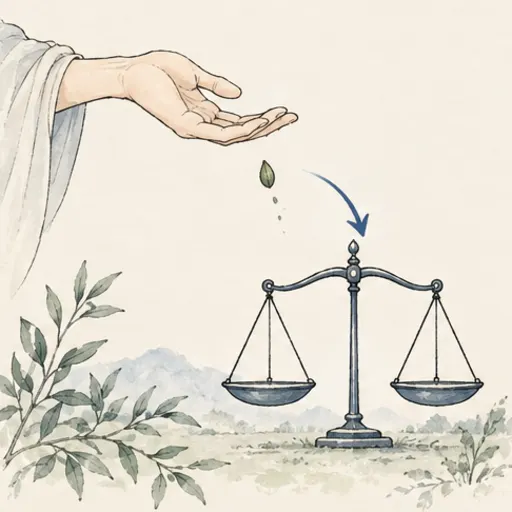
The Indian game asks something harder. It does not tell you that bad children get bitten. It asks you to notice where you actually are. When you land on Greed, the question is not “am I a greedy person?” It is “where is the fear of not having enough showing up in my life this week?” That is karma as attention, not as a ledger.
Playing it this way today
You can play the game of knowledge like that on any evening. Set an intention before the first roll: a question you really want to live with. Then treat every square as a mirror rather than a score.
- When a snake takes you down, name the vice on its head and ask where it has been biting lately.
- When an arrow lifts you, ask what the virtue at its foot would look like on an ordinary Tuesday.
- When you land on a plain square, read its name slowly. Most of the board is plain squares, just like most of a life.
The old designers gave us a race that is really a portrait. The die will do what it does. The rest is how honestly you look at where it puts you.
Roll the die
Set an intention, throw a six to be born, and let the AI guide ask you one question on every cell you land on, all the way to cell 68, Cosmic Consciousness.
Sources and further reading
- Jacob Schmidt-Madsen, The Game of Knowledge: Playing at Spiritual Liberation in 18th- and 19th-Century Western India (PhD thesis, University of Copenhagen, 2019)
- Andrew Topsfield, The Indian Game of Snakes and Ladders, Artibus Asiae 46(3), 1985
- Victoria and Albert Museum: Gyanbazi, Jain game board (CIRC.324-1972)
- Victoria and Albert Museum: Kismet board game, about 1895 (MISC.423-1981)
- Harish Johari, The Yoga of Snakes and Arrows: The Leela of Self-Knowledge (Destiny Books, 2007)