· 5 min read
How to choose an intention for self-reflection
A good intention is a real question, not a wish. How to phrase one for a game of Leela, with examples, three reliable starting points and the traps to avoid.
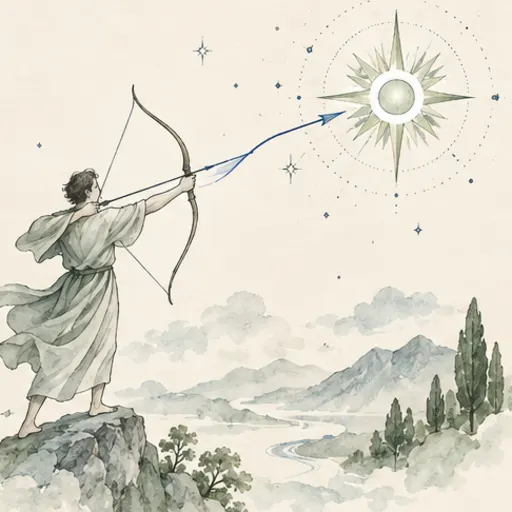
The illustration above belongs to cell 45 of the Leela board, Su-vidya, Right Knowledge. It shows an archer on a hill, bow drawn, looking at something far away. The arrow has not left the string yet. That moment, the one before release, is what this article is about.
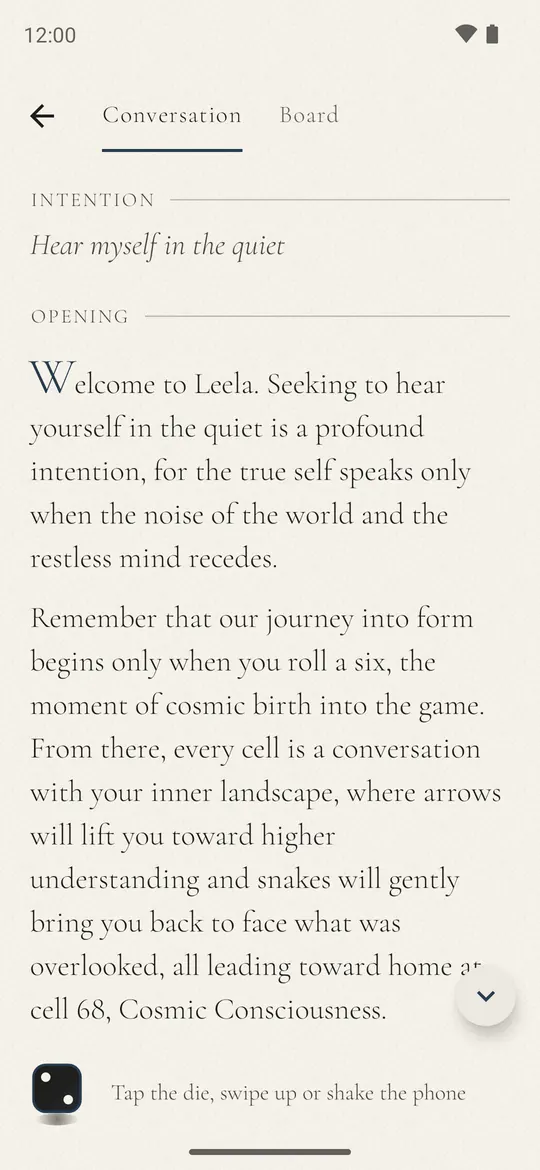
Before your first roll in Leela, the game asks you for a single thing: the question you want to explore. Most people type the first thing that comes to mind and hurry on to the die. It is worth slowing down. The intention you choose quietly shapes every one of the questions that follow, and a vague one makes for a vague game.
Why a game needs an intention at all
Leela has 72 cells, and each one asks you something. Anger asks what your anger is trying to protect. Charity asks what is hardest for you to give. Darkness asks where you have stopped noticing that you are sleepwalking. On their own, these are good questions. Taken together without a common thread, they are a pile of good questions, and piles are hard to learn from.
 3 · Anger
 20 · Charity
 63 · Darkness
An intention is the thread. With one in place, every cell becomes a new angle on the same thing. Land on Jealousy with the intention “What keeps me from living fully?” and the question of what you are afraid of losing takes on a very particular shape. The die chooses the angle. The intention decides what you are looking at.
It is also a kind of commitment. Naming what you want to explore is a small admission that you do not fully understand it yet. That admission is where reflection starts.
A question, not a wish
The most common mistake is to write a wish instead of a question. “I want to be happier.” “I want my relationship to work.” “More money.” These are honest, and there is nothing wrong with wanting them, but a wish gives the game nothing to work with. It is a destination with no road.
Turn the wish around until it becomes something you could actually explore:
- “I want to be happier” becomes “What is quietly draining my joy?”
- “I want my relationship to work” becomes “What do I keep avoiding saying to my partner?”
- “More money” becomes “What am I hoping money will give me?”
Notice what changed. Each new version is open, it points at you rather than at the world, and you do not already know the answer. That last part matters most. If you can answer your intention before the game begins, it is not an intention. It is a conclusion.
Three reliable starting points
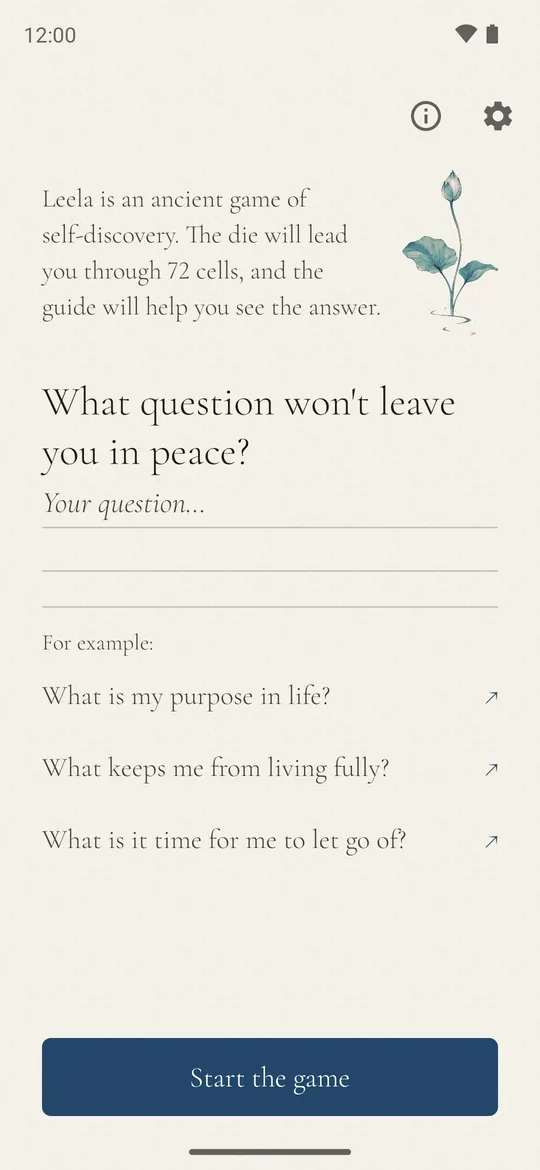
When you open the app, it offers three example intentions. They are worth a closer look, because each one is a well-made question.
What is my purpose in life? The big one. It sounds grand, but it works well in a game because the board is so varied: the physical plane, the plane of action, devotion, fantasy. You will see your purpose reflected in places you would never have searched.
What keeps me from living fully? This is the one to choose when something feels stuck but you cannot say what. It pairs naturally with the snakes, which are, among other things, a map of how we get in our own way.
What is it time for me to let go of? Good for endings, transitions and the months when your life feels crowded. Cells like Purification and the Plane of Elimination will speak to it very directly, but so, less obviously, will Greed and Delusion.
You are welcome to use any of these as they are. They are also good templates for writing your own.
How to phrase your own
A few practical tests for an intention, drawn from what tends to work at the board:
- Write it in the first person. “What do I…” rather than “Why do people…”
- Start with what, where or how. Questions that begin with “should” invite yes or no, and a yes or no closes the conversation.
- Keep it to one subject. “Work, my mother and my health” is three games.
- Size it honestly. Bigger than a to-do item, smaller than the meaning of the universe. “Where am I spending energy I don’t have?” is about right.
- Let it be slightly uncomfortable. If writing it down makes you wince a little, you have probably found the real question.
Some examples at the right scale: What am I pretending not to know about my work? Where in my life am I still waiting for permission? What would change if I stopped trying to prove myself? Why does rest make me anxious?
What to leave out
Some intentions do not suit a game of self-knowledge.
Questions about other people. “Will she come back?” and “Does he respect me?” hand the answer to someone who is not at the table. Turn them back toward yourself: “What am I hoping her return would fix?”
Questions about the future. Leela does not predict anything, and the app does not pretend to. The die gives you a route, not a forecast. Ask about what is happening in you now.
Questions that need a professional. Leela is a game for reflection, not therapy. If your intention is really about a crisis, a diagnosis or your safety, please take it to a person who can actually help.
Holding it lightly
Here is the archer again. Right Knowledge, in the game’s own description, is knowledge that leads to the good, your own and other people’s. Its arrow rises to 67, the Plane of Cosmic Good. The image suggests that aiming well is not about gripping harder. It is about seeing clearly where you are pointing and then letting go.

The same is true of your intention. Choose it with care, then hold it lightly. Somewhere around cell 20 you may discover that the question you brought was covering a different one. That is not a failed game. That is the game working. And when you finally reach cell 68, it will ask you what has changed in you along the way. The answer is usually more interesting than the question you started with.

Roll the die
Set an intention, throw a six to be born, and let the AI guide ask you one question on every cell you land on, all the way to cell 68, Cosmic Consciousness.