· 5 min read
Leela vs Snakes & Ladders: what changed when the game became a children's toy
Same dice, same falls, very different games. A side-by-side look at Leela's 72 named cells and the 100 blank squares of the nursery classic.
Put the two boards side by side and they look like cousins who grew up in different houses. Both have a die. Both have things that lift you and things that drop you. Both end when someone reaches a particular square. And yet one is a race for four-year-olds and the other is a game you might play alone at eleven at night with a cup of tea and a question you have been avoiding.
What exactly changed between them? Quite a lot, and almost none of it is the rules.
The board: names versus numbers
The Snakes and Ladders registered by the London firm F. H. Ayres in 1892, now in the Victoria and Albert Museum, has 100 squares, five snakes and five ladders. The squares carry numbers and nothing else.
Leela, in the form Harish Johari published in 1975, has 72 cells in eight rows of nine, and every one of them has a name. Cell 3 is Anger. Cell 17 is Mercy. Cell 41 is the Human Plane. Cell 68 is Vaikuntha-loka, Cosmic Consciousness. The board has ten snakes and ten arrows, which is what Johari called the ladders.
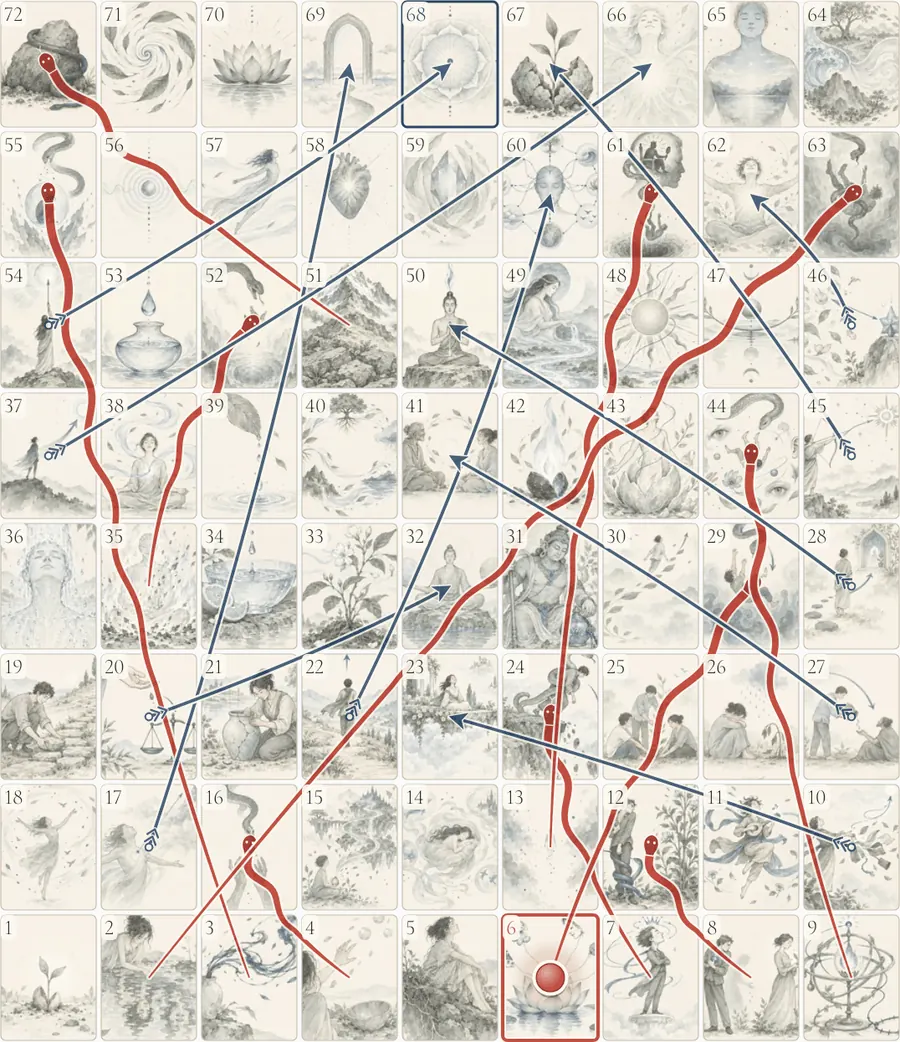
That single difference changes everything that follows. On a numbered board, landing on 47 means you are at 47. On a named board, landing on 47 means you are at Sarasvati, the Plane of Neutrality, and the game asks what you might see if you stopped judging for a while.
The snakes and ladders: meaning versus decoration
On the old Indian boards, the verses on the charts identify the snakes as sins and the ladders as virtues. Leela keeps that logic in every connection. The snake at 55, Egotism, drops you to 3, Anger: when the “I” takes the centre of everything, any disagreement feels like a threat. The arrow at 45, Right Knowledge, lifts you to 67, the Plane of Cosmic Good.
 55 · Egotism
 3 · Anger
The Victorian game kept some of that for a while. A board called Kismet, made around 1895 and also in the V&A, still labels its squares with wrong-doing that leads to punishment and good deeds that lead to virtue. Then the labels went. In the modern nursery version a snake is just a snake, and a ladder is a lucky break.
The start: a six to be born
In most versions of Snakes and Ladders you start at square one and simply move by the number you roll.
In Leela you cannot enter the board at all until you roll a six. The six is the moment of birth, and it places your token on cell 6, Moha, Delusion. It is a sharp little joke: the first place a newborn player arrives is the cell of attachment.
Historians point out that the rule of the six is probably Johari’s own addition rather than an old tradition. It is also one of the best ideas in the game. Waiting for the six is a small lesson in patience before the journey even begins.
The goal: not the last square
In Snakes and Ladders the goal is the last square, and the first one there wins.
In Leela the goal is cell 68, not 72. Above it lie four more cells: the Absolute Plane at 69, True Nature at 70, Activity at 71, and Inertia at 72, whose snake drops you all the way to cell 51, Earth. In the Leela app, a move that overshoots 72 carries on from the start of the board and the journey goes round again. You cannot simply sprint past the goal. You have to land on it, or be carried there by the arrow from 54, Spiritual Devotion.

This is the most philosophical design choice on the board. Being very high is not the same as arriving.
The players: winning versus noticing
Snakes and Ladders is built for several players racing each other. The fun is in comparison: who climbed, who slid, who is ahead.
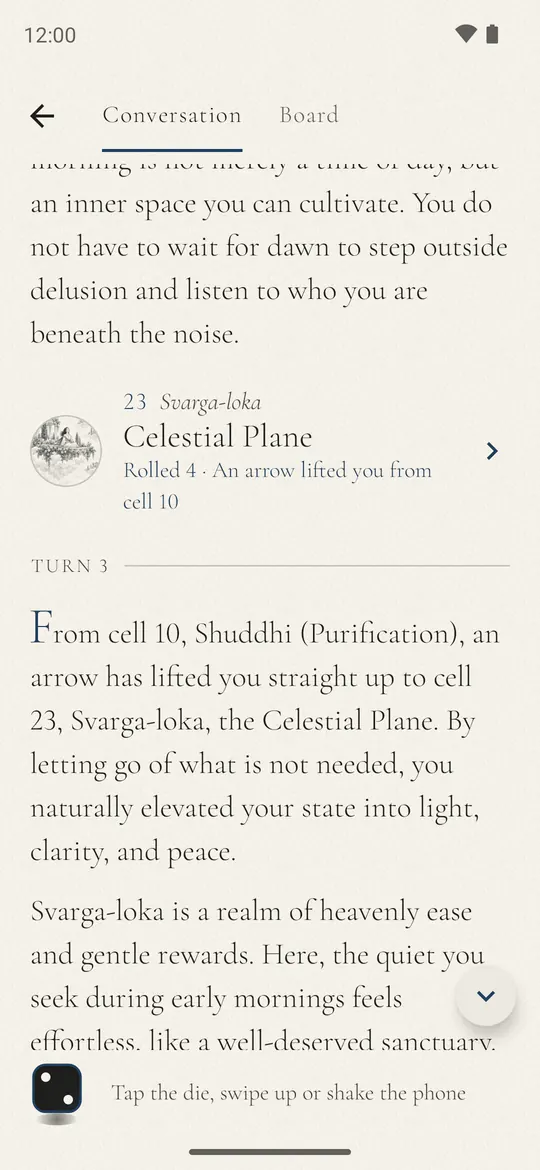
Leela works perfectly well for one person. You begin with an intention, a question such as “What is it time for me to let go of?”, and on every cell you land, you answer the cell’s question in the light of it. In the app, an AI guide asks that question and listens to your answer. There is no opponent. The only other player is the version of you who started the game.
What the toy kept
It would be easy to sneer at the nursery version, and unfair. It kept the parts that made the old game work as a game: the die nobody controls, the sudden fall, the lucky climb, the suspense of the last few squares. That is why it lasted.
What it dropped was the reason to look up from the board. The Indian game of knowledge was a picture of the world and of the person moving through it. Snakes and Ladders is a picture of chance.
So which one should you play?
Both, honestly. Play Snakes and Ladders with a child on a rainy afternoon, and enjoy the shrieks. Play Leela when you want the dice to ask you something back. A good way to feel the difference is to play them a day apart and notice what you remember afterwards. From the nursery game, you will remember who won. From Leela, you will probably remember one question.

Roll the die
Set an intention, throw a six to be born, and let the AI guide ask you one question on every cell you land on, all the way to cell 68, Cosmic Consciousness.
Sources and further reading
- Victoria and Albert Museum: Snakes and Ladders, F. H. Ayres, 1892 (B.892-1993)
- Victoria and Albert Museum: Kismet board game, about 1895 (MISC.423-1981)
- Jacob Schmidt-Madsen, The Game of Knowledge: Playing at Spiritual Liberation in 18th- and 19th-Century Western India (PhD thesis, University of Copenhagen, 2019)
- Harish Johari, The Yoga of Snakes and Arrows: The Leela of Self-Knowledge (Destiny Books, 2007)