· 6 min read
12 journaling prompts from an ancient Indian game
Twelve questions from the cells of Leela, the Indian game of self-knowledge: on anger, envy, rest, dharma and silence, and how to write through them.
Most journaling prompts are written by someone who wants you to feel better by Friday. These ones come from somewhere stranger: a board game. Leela is an old Indian game of self-knowledge, laid out as 72 cells in eight rows, with arrows that carry you up and snakes that bring you back down. Every cell is a state of mind, from Anger and Greed near the bottom to Clarity, Bliss and Cosmic Consciousness near the top.
When we built Leela as an app, we gave each of the 72 cells a single question. You land on a cell, and the guide asks it. Over time we noticed that people kept screenshotting the questions, not the dice rolls. So here are twelve of them, lifted straight from the board, for anyone who wants to write without playing.
How to use these prompts
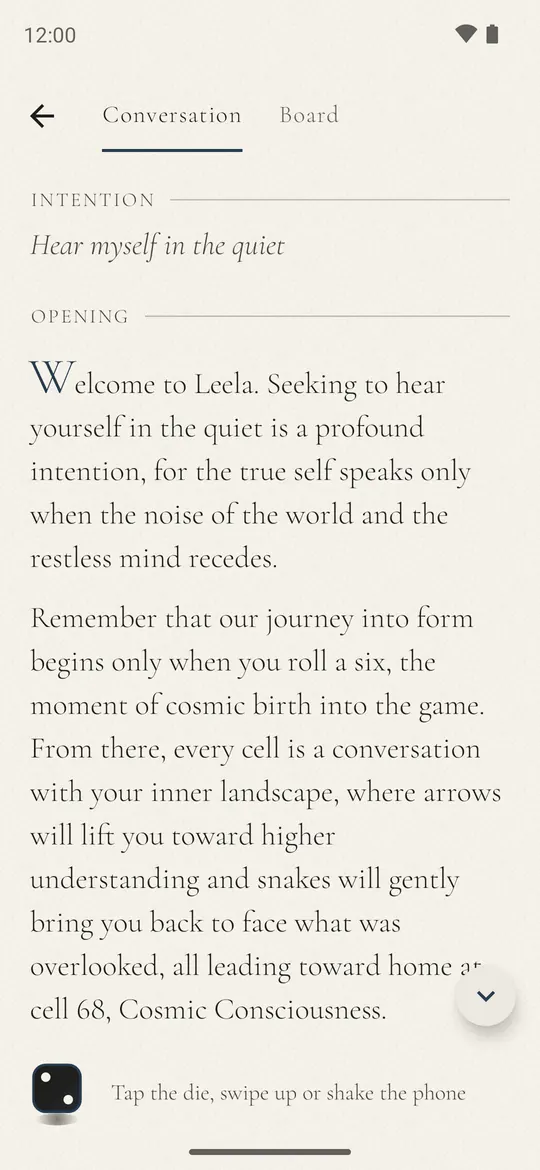
A game has one quality that a list of prompts usually lacks: you do not choose where you land. The die chooses. That small loss of control is useful, because it stops you from skipping the uncomfortable questions and answering only the flattering ones.
You can borrow that trick without a board:
- Roll for it. Number the prompts 1 to 12 and roll two dice, or just open the list at random with your eyes closed. Answer whatever comes up, including the one you were hoping to avoid.
- Write for ten minutes, not for an audience. Short, honest sentences beat elegant paragraphs. If you catch yourself explaining, stop and describe instead.
- Answer the second half. Most of these questions have two parts, joined by a dash. The first part is easy. The second part is where the question actually lives.
- Hold an intention. Leela begins with a question you bring to the board, such as “What is it time for me to let go of?” Read your answers against it. The prompt is general; your intention makes it specific.
Beginnings and attachments
These come from the first row of the board, the level of the body, survival and support. They are the ground floor, and they are more interesting than they look.
 1 · Genesis
 6 · Delusion
 3 · Anger
- What am I bringing into this game, and what does it mean for me to begin again? (Cell 1, Janma, Genesis.) Janma is birth, the first cell of the board. A good prompt for a new notebook, a new month, or a Monday that feels like a restart.
- What am I most attached to, and what would change if I held it more lightly? (Cell 6, Moha, Delusion.) In the game, the six that lets you enter places you right here. Everyone starts in attachment. It is not an accusation; it is the starting square.
- What is my anger aimed at, and what is it trying to protect? (Cell 3, Krodha, Anger.) Anger on the Leela board sits next to safety and boundaries. The prompt assumes your anger has a reason. Find it.
- What do I feel I have too little of, and how much would truly be enough? (Cell 4, Lobha, Greed.) Greed here is read as the fear of not having enough. Put a number on “enough”, even a rough one.
Desire, rest and other people
The second and third rows are where desire lives, and where it turns into action. The questions get a little more social.
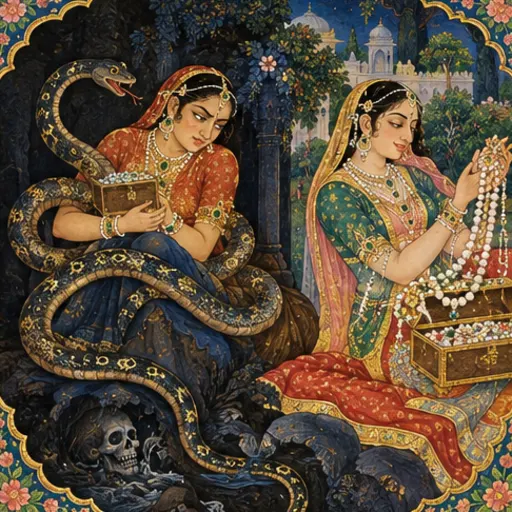
- Whom do I envy, and what desire of my own is that envy really pointing to? (Cell 12, Irshya, Envy.) Envy is information wearing an ugly coat. Write down the name, then write down what you actually want.
- Is my rest right now a way to recover, or a way to get away from something? (Cell 11, Gandharva-loka, Entertainment.) Music, play and lightness are real goods on this board. The question is only which way they are carrying you.
- What do I give easily, and what is hardest for me to give? (Cell 20, Dana, Charity.) In the game, Charity is an arrow that lifts you to the Plane of Balance. Time, attention and praise are all things you can give; notice which one you hoard.
- Where do I live by my own law, and where by other people’s expectations? (Cell 22, Dharma-loka, Plane of Dharma.) Dharma is your inner law, the way of acting that is natural for you. Make two columns. Be honest about the length of the second one.
Clarity, silence and what remains
The upper rows are quieter. The questions stop asking what you want and start asking what you actually see.

- What do I know not from books, but from my own experience? (Cell 37, Jnana, True Awareness.) Jnana is knowing that changes the one who knows. List three things you learned the hard way. They are worth more than anything you have highlighted.
- What would remain of my situation if I removed all the stories I tell about it? (Cell 59, Satya-loka, Plane of Reality.) Describe your problem as a camera would. No motives, no adjectives, no “always”. It usually gets smaller.
- How much silence is there in my day? (Cell 65, Uranta-loka, Plane of Inner Space.) Answer in minutes, not in feelings. Then decide whether the number is the one you want.
- What has changed in me during this game, and what will I carry with me? (Cell 68, Vaikuntha-loka, Cosmic Consciousness.) This is the question at the goal of the board. Use it to close a week of journaling, or a year.
Why a game makes better prompts
There is a reason these questions feel different from a generic list. Each one belongs to a place on a map. Anger sits low on the board, near greed and delusion. Charity is an arrow; envy is a snake that drops you back to avarice. When you answer a Leela question, you are not only answering it, you are also locating yourself: this is the row I seem to be living on this week.
That is the quiet point of the old game. It does not grade you. A snake is not a punishment and an arrow is not a prize. They are just descriptions of how states of mind tend to lead into one another, drawn by people who had watched minds for a long time.
Write the answer you have, not the answer you would like to have.
If a prompt lands hard, stay with it for a day instead of rushing to the next one. If it bores you, that is also worth a line: boredom is often a question you have already decided not to ask. And if you find yourself wanting a thirteenth prompt, there are sixty more waiting on the board.

Roll the die
Set an intention, throw a six to be born, and let the AI guide ask you one question on every cell you land on, all the way to cell 68, Cosmic Consciousness.