
· 5 min read
The history of Leela: from Gyan Chaupar to the game on your phone
A dated chronicle of the Indian game of knowledge: Hindu, Jain and Sufi boards, the Victorian Snakes and Ladders, and Harish Johari's revival as Leela.
Every old game collects legends, and this one has more than most. Search for its history and you will be told it is two thousand years old, or that a 13th-century saint invented it, or that it was played in Jain temples since time immemorial. The real story is shorter, better documented, and in places stranger. Here it is, in order, with the dates we can actually stand behind.
Before the boards: the ideas
The ideas the game plays with are ancient: karma, rebirth, the ascent of the soul through higher and higher worlds toward liberation. They run through Hindu, Jain and Buddhist thought for well over two thousand years. The board game that turned them into a dice race is much younger. When people say “Leela is ancient”, this is the honest version: an old philosophy in a comparatively young game.

Late 1600s to 1700s: the game of knowledge appears
The historian Jacob Schmidt-Madsen, whose 2019 doctoral thesis at the University of Copenhagen is the most thorough study of the game so far, places its emergence in western India, probably in the late 17th or early 18th century, and not earlier than the late 17th century.
By then it had many names, one for each community that played it:
- Gyan chaupar, “the game of knowledge”, among Vaishnava Hindus;
- Gyan bazi, with the same meaning, among Jains in Gujarat and Rajasthan;
- Mokshapat, the board of liberation, in Maharashtra;
- Paramapada sopanam, the ladder to Vishnu’s highest heaven, in Tamil Nadu;
- Vaikunthapali in Andhra;
- and among Sufis, a Persian name meaning “the chess of the wise”.
1780–82: the oldest board we can date
The earliest chart that can be dated with confidence is a 72-square Vaishnava board made in Lucknow around 1780–82 for Richard Johnson, a British official and collector. It survives in the British Library. The earliest dated Jain chart is from 1797.
For a long time a Jain chart dated 1735 was cited as the oldest. Schmidt-Madsen argues it should now be treated with scepticism. That kind of revision is typical of this field: the more carefully boards are examined, the younger the confident claims tend to become.
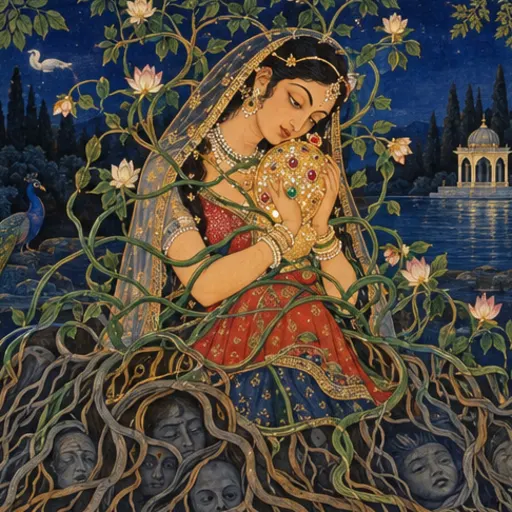 6 · Delusion
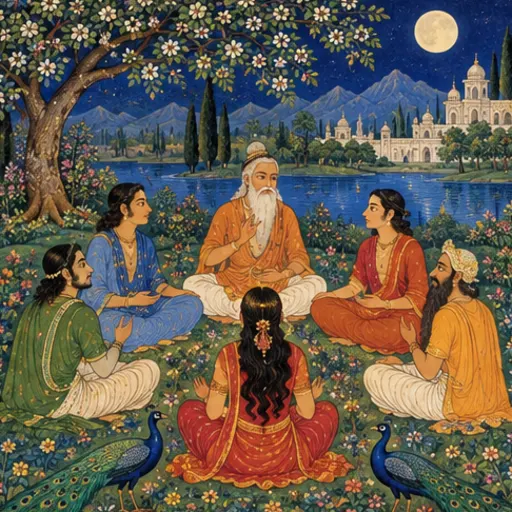 41 · Human Plane
 68 · Cosmic Consciousness
Three families of boards
In 1985 the art historian Andrew Topsfield published the first major study of the game, and he sorted the surviving boards into three main families by the number of squares:
- 72 squares on Hindu, mostly Vaishnava, boards;
- 84 squares on Jain boards, and some Vaishnava ones;
- 100 squares on Sufi boards.
Rarer charts go far beyond that, with 124, 342, even 500 squares. Topsfield returned to the subject in 2006 with further discoveries and in 2021 with a note on the Sufi boards. The squares were painted with the names of virtues and vices, heavens and hells, and the snakes and ladders linked them into a map of moral cause and effect.
1831: the first mention in print
The earliest written reference known in English appears in The Asiatic Journal in May 1831, describing a “game of Heaven and Hell” presented to the Royal Asiatic Society. It is a board of 124 squares from Pune, made around 1800.
1872: the Dnyaneshwar legend
You may read that the Marathi poet-saint Dnyaneshwar invented the game in the 13th century. Schmidt-Madsen traced this story. It appears in Maharashtrian sources only from 1872 onward, and there is no evidence for it before the second half of the 19th century. In his reading it is a local claim to originality. It is a lovely legend. It is not history.
1892: Snakes and Ladders in London
In October 1892 the London firm F. H. Ayres registered a spiral design called Snakes and Ladders. The copy in the Victoria and Albert Museum has 100 squares, five snakes and five ladders, and no heavens or hells. A few months later, in March 1893, Richard Harte of Croydon patented a game of “arrows and ladders”. A popular claim that the firm of Jaques published the game in 1888 cannot be verified.
1943: Chutes and Ladders
In the United States, Milton Bradley released Chutes and Ladders in 1943: 100 squares, ten chutes and nine ladders. The snakes had become playground slides. What happened to the meaning along the way is a story of its own, and we tell it in the comparison of Leela and Snakes & Ladders.
1975: Harish Johari brings back the names
In 1975 the Indian author and artist Harish Johari published Leela: The Game of Self-Knowledge in New York. He said he had adapted his board from an early 19th-century chart from Uttar Pradesh: 72 cells, from Genesis at the bottom to Tamo-guna, Inertia, at the top, with Vaikuntha-loka, Cosmic Consciousness, at cell 68 as the goal. He called the ladders arrows, and he wrote a commentary on every cell.
Schmidt-Madsen notes that some of Johari’s rules, such as needing a six to be born onto the board, are probably his own additions rather than inherited tradition. Johari’s claims about the game’s great age are also not supported by the evidence. His real contribution is different: he turned a museum object back into something people could play with their full attention.
The book was reissued as a boxed set with a board in 1993, and in 2007 Destiny Books published a new edition as The Yoga of Snakes and Arrows.

Today: the board in your pocket
The Leela app and the browser game at leelagame.app use Johari’s 72-cell board, its ten snakes and its ten arrows. What is new is the guide: on every cell you land on, it asks you one question about your intention, and listens to your answer.
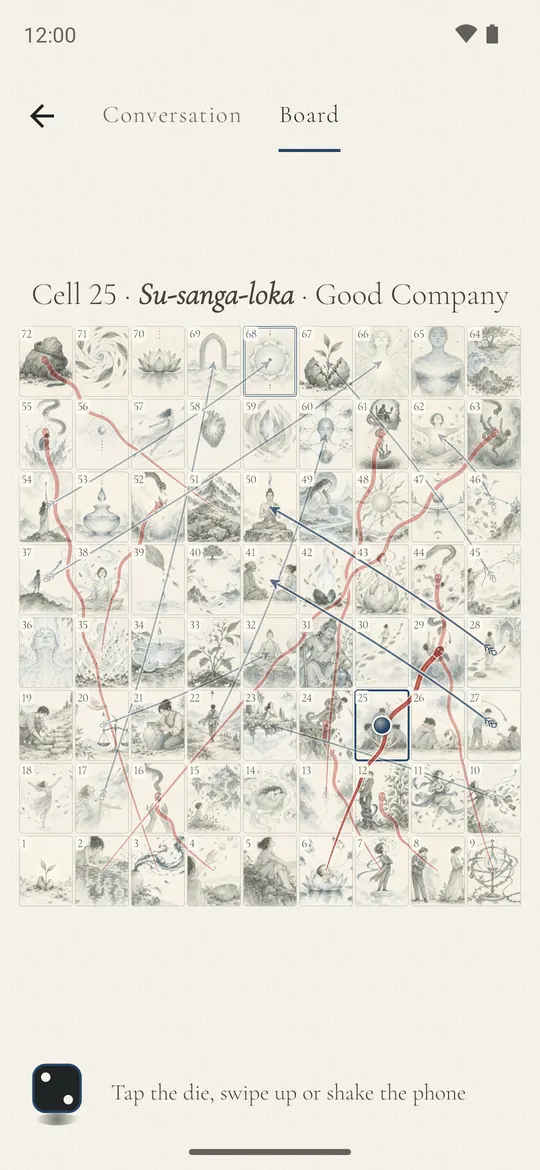
The game remains what the old boards were: a slow walk through a map of the mind, with a die deciding the route.
Three centuries is not two thousand years. It is still a long time for a game to keep asking the same question.

Roll the die
Set an intention, throw a six to be born, and let the AI guide ask you one question on every cell you land on, all the way to cell 68, Cosmic Consciousness.
Sources and further reading
- Jacob Schmidt-Madsen, The Game of Knowledge: Playing at Spiritual Liberation in 18th- and 19th-Century Western India (PhD thesis, University of Copenhagen, 2019)
- Andrew Topsfield, The Indian Game of Snakes and Ladders, Artibus Asiae 46(3), 1985
- Andrew Topsfield, Snakes and Ladders in India: Some Further Discoveries, Artibus Asiae 66(1), 2006
- Andrew Topsfield, A Note on Sufi Snakes and Ladders, Journal of the Royal Asiatic Society, 2021
- Victoria and Albert Museum: Snakes and Ladders, F. H. Ayres, 1892 (B.892-1993)
- Victoria and Albert Museum: Gyanbazi, Jain game board (CIRC.324-1972)
- Harish Johari, Leela: The Game of Self-Knowledge (1975), Internet Archive record
- Harish Johari, The Yoga of Snakes and Arrows: The Leela of Self-Knowledge (Destiny Books, 2007)