
· 5 min read
A 15-minute evening reflection ritual
A simple minute-by-minute evening practice built around one question from the Leela board: arrive, choose a cell, write, read back and close the day in silence.
Cell 65 of the Leela board is Uranta-loka, the Plane of Inner Space. It sits in the top row, three cells short of the goal, and it asks one of the plainest questions on the board:
How much silence is there in my day?
For most of us, on most days, the honest answer is: not much. The day ends the way it ran, with a screen, a list, a half-finished conversation in your head. Then you sleep, and tomorrow starts in the middle of the same noise.
This is a small ritual for closing the day on purpose. It takes fifteen minutes. It needs no special equipment, no candles, and no belief in anything. It is built around a single question from the Leela board, because a good question does more work in a quarter of an hour than a blank page does in an evening.
What you need
- A place where you will not be interrupted for fifteen minutes. The kitchen table after dinner is fine.
- Something to write with. Paper is better than a phone, if only because paper does not send notifications.
- A question. Either your ongoing game of Leela, or a single cell chosen on purpose. More on that below.
- A timer, so you can stop watching the clock.
Put the phone face down, or in another room once you have what you need from it. The ritual works because it is short and bounded. Fifteen minutes, then it is over.

The ritual, minute by minute
Minutes 0 to 2: Arrive
Sit down. Let your hands rest. Take a few slow breaths, not as a technique, just to mark the edge between the day and this. Notice what your body is still carrying: a tight jaw, shoulders near your ears, the leftover speed of the afternoon. You do not have to fix any of it. You are only taking attendance.
Minutes 2 to 4: Choose the question
There are two good ways to find tonight’s question.
Let the die choose. If you have a game of Leela in progress, open it and roll once or twice. The app keeps your games under My games, so a single evening can simply be the next few cells of a longer journey. Wherever the token stops, the guide asks that cell’s question. That is your question for tonight, even if it seems to have nothing to do with your day. Especially then.
Choose a cell on purpose. Some evenings you already know what needs looking at. A few cells that suit particular kinds of days:
- After a conflict: 3, Anger. What is my anger aimed at, and what is it trying to protect?
- After a day of rushing: 71, Activity. Is my busyness carrying me forward, or scattering me?
- After a flat, heavy day: 72, Inertia. Where is inertia holding me, and what would help me move?
- After a good day: 62, Happiness. When did I last feel good for no reason at all?
- On any day at all: 65, the Plane of Inner Space. How much silence was there today?
Write the question at the top of the page.
 3 · Anger
 71 · Activity
 72 · Inertia
 62 · Happiness
Minutes 4 to 11: Write
Seven minutes, without stopping and without editing. Start from a specific moment of today, not a general truth about your life. “At lunch, when Sam made that comment” will take you further than “I am someone who gets defensive.”
If you run out of things to say, write the question again and keep going. If you find yourself writing about something that seems off-topic, follow it. Off-topic is often where the real answer is hiding. Spelling, grammar and fairness to yourself can all wait until tomorrow.
Minutes 11 to 13: Read it back
Stop writing. Read what you wrote from the beginning, slowly, as if a friend had written it. Underline one line: the one that surprises you, or the one you would rather not have written. You do not need to do anything with it. Just see it.
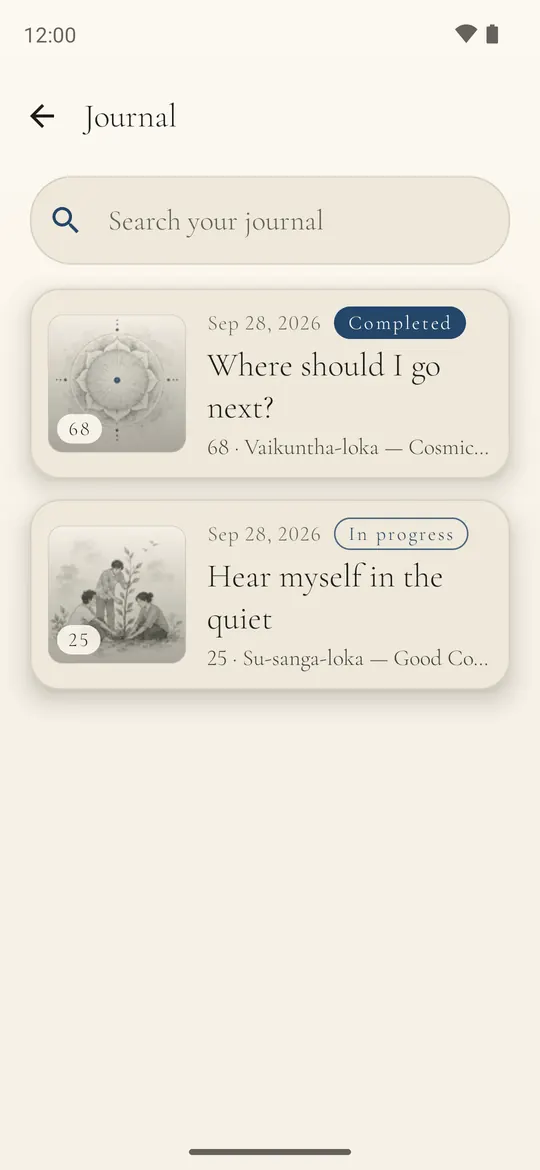
If you are playing in the app, this is a good moment to give the guide your answer, in a sentence or two, based on the line you underlined. The Path tab will keep it, next to the cell and the question, so that later you can look back over a week of evenings as a single road.
Minutes 13 to 15: Silence
Close the notebook. Sit for two more minutes with nothing to do. No question, no review, no planning for tomorrow. This is the part people skip, and it is the part cell 65 is quietly asking about. The Plane of Inner Space is described as the silence within, the silence that holds everything, where nothing is in the way. Two minutes is not much. It is also, on many days, more than there has been so far.

When the timer goes, you are done. Go and brush your teeth.
Why a game works better than a blank page
A blank journal has one great weakness: you choose what to write about, and you tend to choose what you already understand. A board with 72 questions and a die takes that choice away. Some evenings you will land on Mercy and write something tender. Some evenings you will land on Negative Intellect and have to admit what reasons you find for not doing what you believe matters.
The snakes help too, oddly. Sliding from Egotism down to Anger in the middle of a ritual is irritating, and irritation is honest. It is hard to be polished with yourself while the die is making fun of you.
If you miss a day
You will. That is fine. There is no streak to protect and nothing to catch up on. The board waits exactly where you left it, and so does the question.
One last note: this is a game for reflection, not therapy. If an evening brings up something heavy, let it be the start of a conversation with someone you trust, not the end of one on paper. For most evenings, though, fifteen minutes and one good question are enough to end the day a little more awake than it began.

Roll the die
Set an intention, throw a six to be born, and let the AI guide ask you one question on every cell you land on, all the way to cell 68, Cosmic Consciousness.