· 5 min read
An Indian game of self-knowledge for Diwali evenings
Diwali has an old custom of dice games. This year, on the night of 8 November 2026, try one where the die asks questions instead of taking bets.
Every Diwali has its sounds: the scrape of a matchstick, the hiss of a sparkler, a door opened for guests, and somewhere, the rattle of dice. The festival of lights has an old and well-documented taste for games of chance. This year the main night of Diwali, Lakshmi Puja, falls on Sunday, 8 November 2026 (by the Drik Panchang calendar for New Delhi; dates for the days around it shift a little by city).
This is a small proposal for one of those evenings. Keep the dice. Change the question.
Why there are dice at Diwali at all
The custom of playing dice and cards around Diwali is not a modern invention. Britannica notes that gambling is encouraged at Diwali in remembrance of the dice games that Shiva and Parvati played on Mount Kailash. In the traditional Hindu calendar, the first day of the bright half of the month Kartika, the day after the new moon of Diwali, is associated with dice play, dyuta krida. In 2026 that falls on 10 November in New Delhi. Scholars writing on Indian festivals have described the custom for a century.
The story behind it is a good one. In the best-known telling, Shiva and Parvati sit down to dice, and Parvati keeps winning. The divine couple plays, argues, laughs. The game is a way of being together, not of settling accounts.
An honest note about Gyan Chaupar
It would be convenient to tell you that the Indian game of snakes and ladders, gyan chaupar, “the game of knowledge”, was traditionally played at Diwali. There is no source for that, and we would rather not invent one.
What we do know is this. The Diwali dice custom belongs to chaupar, the cross-shaped race game, and to cards. The historian Jacob Schmidt-Madsen, who studied the game of knowledge for his doctoral thesis, points out that in South India its cousin paramapada sopanam is played on other holy nights, notably Vaikuntha Ekadashi and Mahashivratri, when people stay awake. He suggests that festival play of the game of knowledge may mirror the older Diwali dice custom, but he does not claim a direct link, so neither do we.
So this is not a revived tradition. It is a suggestion: a festival that already makes room for dice, and a board that already asks what lifts us and what brings us down.
Why the board fits the night
Diwali is about light winning over darkness, and about beginnings. Houses are cleaned before the festival; new account books are opened; in Gujarat the next day is celebrated as the New Year. It is one of the few evenings in the year when a whole family is already thinking about what to clear out and what to invite in.
Leela, the game of self-knowledge in the form Harish Johari published in 1975, is built on the same movement. Its 72 cells run from Genesis and Illusion at the bottom to Cosmic Consciousness at cell 68. Some of them could have been written for this night:
 10 · Purification
 58 · Plane of Radiation
 63 · Darkness
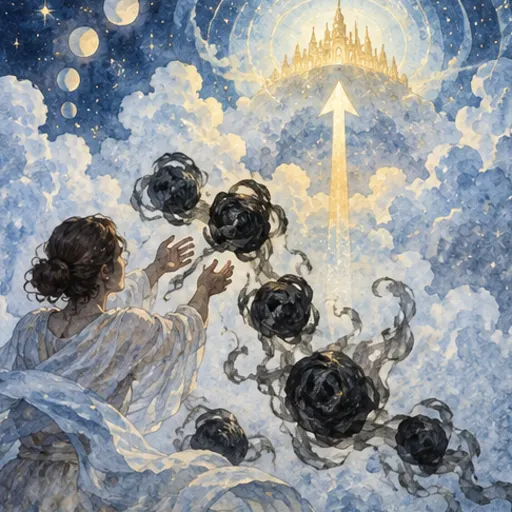
- Cell 10, Shuddhi, Purification. Letting go of what is not needed. An arrow rises from here to the Celestial Plane. The question: What could I let go of right now to make things lighter?
- Cell 42, Agni-loka, the Plane of Fire. Fire turns what burns into light and warmth, the way experience turns into understanding. The question: What in me is being transformed right now?
- Cell 58, Teja-loka, the Plane of Radiation. Here inner light becomes visible to others. The question: What light in me do others notice before I do?
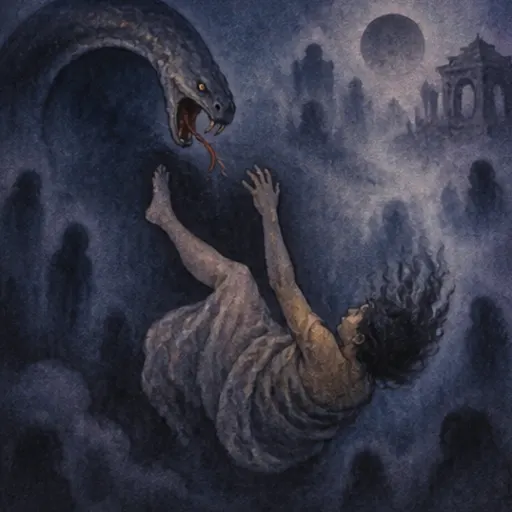
- Cell 63, Tamas, Darkness. A snake drops from here all the way to Illusion. The question: Where do I stop noticing that I am sleepwalking?
That last one belongs at Diwali too. A festival of lights only makes sense if you admit there is darkness to light.
How to play it on a festival evening
You do not need a board, a teacher or a special mood. You need a quiet corner after the puja and the sweets, about half an hour, and a willingness to answer honestly.
- Light one lamp for the game. A diya on the table marks the time as different from the rest of the evening. When it is lit, phones go face down.
- Set one intention each. Not a wish for luck. A question you actually want to live with in the coming year: What is it time for me to let go of? works beautifully at Diwali.
- Wait for the six. In Leela you cannot enter the board until you roll a six. The six places you on cell 6, Moha, Delusion. It is a humbling and accurate place to start.
- Answer the cell, not the scoreboard. Every time you land, read the question aloud and answer it in a few sentences. If you are playing with family, the others listen and do not comment. That is the whole discipline.
- Stop when the lamp burns low. You do not have to reach cell 68 tonight. A game can be paused and picked up on another evening of the festival.
With children, keep it light and keep the questions simple. With parents or grandparents, you may be surprised by what a single cell brings out.
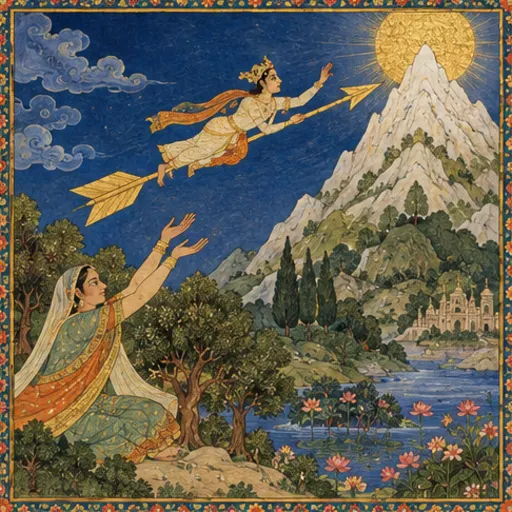
Somebody lands on Mercy and tells a story from 1987 you have never heard.
A game that plays back
The old dice games of Diwali are about fortune: who wins the pot tonight, whose luck turns with the new year. Leela asks for a different kind of fortune. Not what you get, but what you notice. The snakes do not take your money; they take you back to Anger, Greed or Illusion and ask you to look around. The arrows do not pay out; they carry you up because you were generous, or truthful, or devoted.
In that sense the game is close to the spirit of the festival. Lakshmi is welcomed into a clean, lit house. Leela asks for a clean, lit mind. Neither happens by chance, even when you roll the dice.
Before you blow out the lamp
End the evening with the question that Leela asks on its final cell, whether or not anyone got there: What has changed in me during this game, and what will I carry with me?
Say it out loud. Write it down if you like. Then let the lamp burn out on its own, the way it is supposed to.
Happy Diwali.
Roll the die
Set an intention, throw a six to be born, and let the AI guide ask you one question on every cell you land on, all the way to cell 68, Cosmic Consciousness.
Sources and further reading
- Encyclopaedia Britannica: Diwali
- Drik Panchang: 2026 Diwali Puja Calendar
- Jacob Schmidt-Madsen, The Game of Knowledge: Playing at Spiritual Liberation in 18th- and 19th-Century Western India (PhD thesis, University of Copenhagen, 2019)
- Harish Johari, The Yoga of Snakes and Arrows: The Leela of Self-Knowledge (Destiny Books, 2007)