· 5 min read
The arrows that lift you: the ten virtues of the Leela board
Mercy, charity, dharma, devotion: the ten arrows of Leela, where each one carries you, and what they suggest about the qualities that move a life upward.
Everyone remembers the snakes. They are dramatic, they undo your progress, and children shriek at them. The arrows get less attention, which is a pity, because on the Leela board they are the more interesting half of the design. Where the snakes describe how states of mind drag you down, the arrows describe the qualities that lift you, often several rows at once.
Leela, the ancient Indian game of self-knowledge, has ten arrows. Each one starts on a named cell and ends on another. Read them in order and you get a short, surprisingly practical list of virtues, along with a claim about where each one leads.
Arrows from the lower rows
The first five arrows start in the rows of desire and action. That alone is worth pausing on: the board does not keep its virtues at the top. You can find them on the ground floor.
Purification (10) to the Celestial Plane (23). Shuddhi is letting go of what is not needed: habits, built-up tension, whatever no longer serves. It carries you up into the next row, to Svarga-loka, the celestial plane, a bright and pleasant place. The board adds a quiet warning: by tradition, a stay in heaven lasts only until your merit is spent. Lightness is a gift, not the end of the road.
Mercy (17) to the Absolute Plane (69). The longest arrow on the board starts here. Daya is compassion, the ability to feel another’s pain and answer it without calculation. It sits in the second row, among envy and jealousy, and it lifts you almost to the top. There is a twist: 69 lies just past the goal at 68. The token only moves forward, so the way home now runs through a new round or through the snake at 72. Even the most generous heart can overshoot.
Charity (20) to the Plane of Balance (32). Dana is giving time, attention, money or strength without keeping score. In giving, you stop clinging to what is yours, and the inner scales even out. This is one of the most concrete arrows on the board: you can practise it before lunch.

Dharma (22) to Positive Intellect (60). Dharma-loka is the plane of your inner law, the way of acting that is natural for you. When your actions agree with that law, the arrow says, the mind grows clear and serves the whole. It is a long climb, from the third row to the seventh.
Selfless Service (27) to the Human Plane (41). Paramartha is acting for something larger than yourself, freely. It closes the row of action and lifts you to Jana-loka, the plane of the sages, where knowledge is passed from person to person. Serving others, the board suggests, is how you learn what being human means.
Arrows from the upper rows
Apt Religion (28) to the Plane of Austerity (50). Sudharma is faith and practice that truly fit you, rather than ones inherited out of habit. A practice that is alive and your own gives you strength for tapas, a discipline that does not punish but releases energy. The order matters: fit first, discipline second.
True Awareness (37) to the Plane of Bliss (66). Jnana is direct realisation, knowing that changes the one who knows. It lifts you to Ananda-loka, the joy of being, with no object needed. Not information, but the kind of understanding you cannot un-know.
Right Knowledge (45) to the Plane of Cosmic Good (67). Su-vidya is knowledge that leads to the good, your own and other people’s. It carries you to Rudra-loka, one cell below the goal. From there the die has to show exactly one. Being close, the board reminds you, is not the same as arriving.
Conscience (46) to Happiness (62). Viveka is discernment: telling the eternal from the passing, the essential from the accidental. When you can see what truly matters, a quiet joy arrives. It is a lovely arrow, because it links happiness not to luck but to clear seeing.

Spiritual Devotion (54) to Cosmic Consciousness (68). Bhakti is love as a path, devotion in which you stop holding on to yourself. This is the only arrow that lands exactly on the goal. Many readers find that telling: the board’s most direct route home is not knowledge or discipline but wholehearted love.
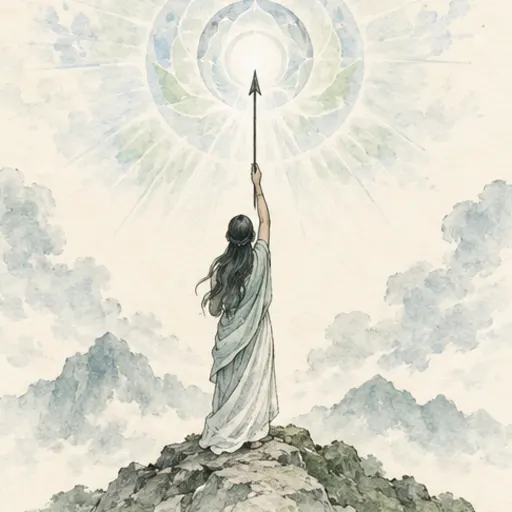 54 · Spiritual Devotion
 68 · Cosmic Consciousness
What the arrows have in common
Put the ten side by side and a pattern appears. Almost every arrow is a movement away from the self: letting go, compassion, giving, service, devotion. Even the arrows of knowledge are about knowledge that serves more than just you. The snakes, by contrast, are nearly all about the self gripping harder: envy, jealousy, egotism, a mind that makes excuses for itself.
The snakes tighten your grip. The arrows loosen it.
A few other things stand out:
- Arrows start low. Five of the ten begin in the first three rows. Virtue is not reserved for the advanced.
- Arrows can overshoot. Mercy flies past the goal; Right Knowledge stops one cell short. Neither is a failure. They are reminders that arrival is its own moment.
- You cannot aim for an arrow. In the game, the die decides. What you can do is notice, when you land on one, what that quality would ask of you today.
Taking one arrow home
Choose one arrow from the list, the one that feels most out of reach. Then look for the smallest version of it you could practise this week. Not devotion, perhaps, but ten minutes of full attention to someone you love. Not selfless service, but one favour done without mentioning it. The board is generous: even the smallest arrow still points up.
Roll the die
Set an intention, throw a six to be born, and let the AI guide ask you one question on every cell you land on, all the way to cell 68, Cosmic Consciousness.